Fire Extinguisher Safety at Work
For workers in any workplace where portable fire extinguishers are provided for employee use: where extinguishers must be and who may use them, matching the extinguisher to the class of fire, what a fire needs, how to recognize the common extinguishers and read their rating, the P.A.S.S. technique, when to evacuate instead, and the monthly, yearly and 6-year checks.
Need proof of training? The full course (20 min) adds practice questions, a job scenario, the final quiz and a certificate your employer can verify.
Take the courseMounted, marked and close by
- Mounted and marked. Your employer mounts the extinguishers and marks where they are. You can reach one fast without getting hurt.
- Full and in place. Each one is full and works. It stays in its spot unless someone is using it.
- Close enough. Inside a building, you walk 75 feet or less to reach one for ordinary fires (Class A). For flammable liquids (Class B), it is 50 feet or less from where they are used. These walking limits do not apply outside buildings. They also do not apply where only a few named workers use extinguishers and everyone else leaves.
Reference: 29 CFR 1910.157(c)(1) · 29 CFR 1910.157(c)(4) · 29 CFR 1910.157(d)(2) · 29 CFR 1910.157(d)(4) · 29 CFR 1910.157(a) · 29 CFR 1910.157(b)(2)
Are you expected to use one?
Who may use them depends on your employer's plan. Ask which one fits your job:
- Workers may use them. Then your employer must teach you how to use one, and the dangers of fighting a fire in its first stage (the incipient stage).
- Only named workers use them. Some plans name a few workers. Everyone else in the fire area leaves right away when the alarm sounds. The named workers are trained on the right equipment.
- Not for workers. In some workplaces the extinguishers are not for workers, or everyone must leave when the alarm sounds. There, follow your employer's emergency action plan.
Reference: 29 CFR 1910.157(b)(2) · 29 CFR 1910.157(g)(1) · 29 CFR 1910.157(g)(3) · 29 CFR 1910.157(a) · 29 CFR 1910.157(b)(1) · U.S. Fire Administration, Fire Extinguishers · City of Ramsey (MN) Fire Department, Fire Extinguishers
Want the certificate? Practice this rule with real job scenarios and get a certificate your employer can verify.
Start the courseWhat a fire needs
A fire needs four things at the same time:
- Fuel. Something that burns.
- Heat. Enough to bring the material to its ignition temperature.
- Oxygen. Enough to keep it burning.
- The chemical reaction. The burning itself.
Reference: OSHA eTool, Portable Fire Extinguishers: Extinguisher Basics
Fire classes on the label
Two mistakes that make it worse
- No water on electrical fires. Water conducts electricity and can lead to electrocution.
- No water on flammable liquid fires. Water does not put them out well and can spread the fire.
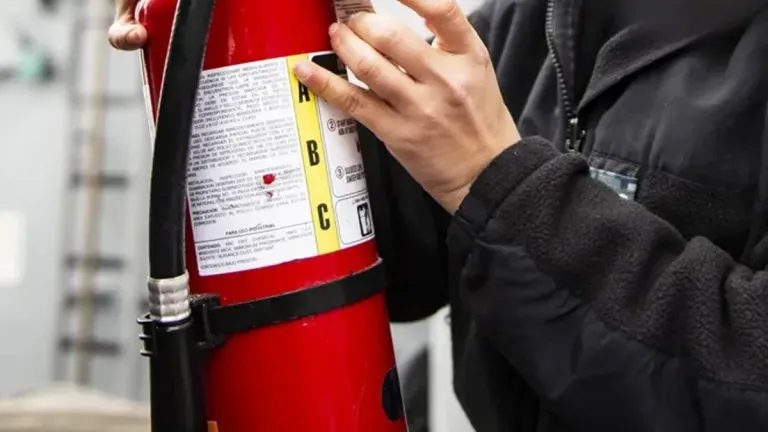
Read the letters on the label before you use an extinguisher. The letters show the types of fire it is approved for.
Reference: OSHA eTool, Portable Fire Extinguishers: Extinguisher Basics
Know the extinguisher in front of you
- Water (APW). A large silver container. For Class A fires only: wood, paper, cloth, rubber and certain plastics.
- Carbon dioxide (CO2). A hard horn and no pressure gauge. For Class B and C fires only. Not for Class A fires, which can smolder and flare up again. Never use one in a small closed space with people inside, unless they wear the right breathing protection.
- Dry chemical. The label shows the classes it may be used on, A, B and/or C. A multi-purpose ABC unit covers all three.
Reading the rating
A label such as 1-A:10-BC tells you two sizes. Each unit in front of the A equals 1.25 gallons of water. The number in front of the B is how many square feet of liquid fire a regular person should be able to put out.
Reference: OSHA eTool, Portable Fire Extinguishers: Extinguisher Basics
Fight it only if all five are true
Your plan lets you use extinguishers. A fire starts. Before you grab one, check all five:
- The alarm is going. Others are warned and someone has called the fire department.
- It is small. The fire is on one thing, like a wastebasket.
- You are out of the smoke. Fire smoke is toxic.
- Your way out is clear. The fire is not between you and your exit.
- You feel sure. Your gut says it is safe to try.
Can you handle it?
An extinguisher holds only a little agent. Some people find one too heavy to hold or too hard to squeeze. That is a reason to leave, not to try.
Reference: U.S. Fire Administration, Fire Extinguishers · City of Ramsey (MN) Fire Department, Fire Extinguishers · OSHA eTool, Portable Fire Extinguishers: Fire Extinguisher Use
P.A.S.S.
Before you approach the fire
- Sound the alarm and call the fire department, if appropriate.
- Find your way out first. Pick a safe way out before you go near the fire. Do not let the fire, heat or smoke come between you and that path.
- Pick the right extinguisher for the class of fire.
Then use P.A.S.S.
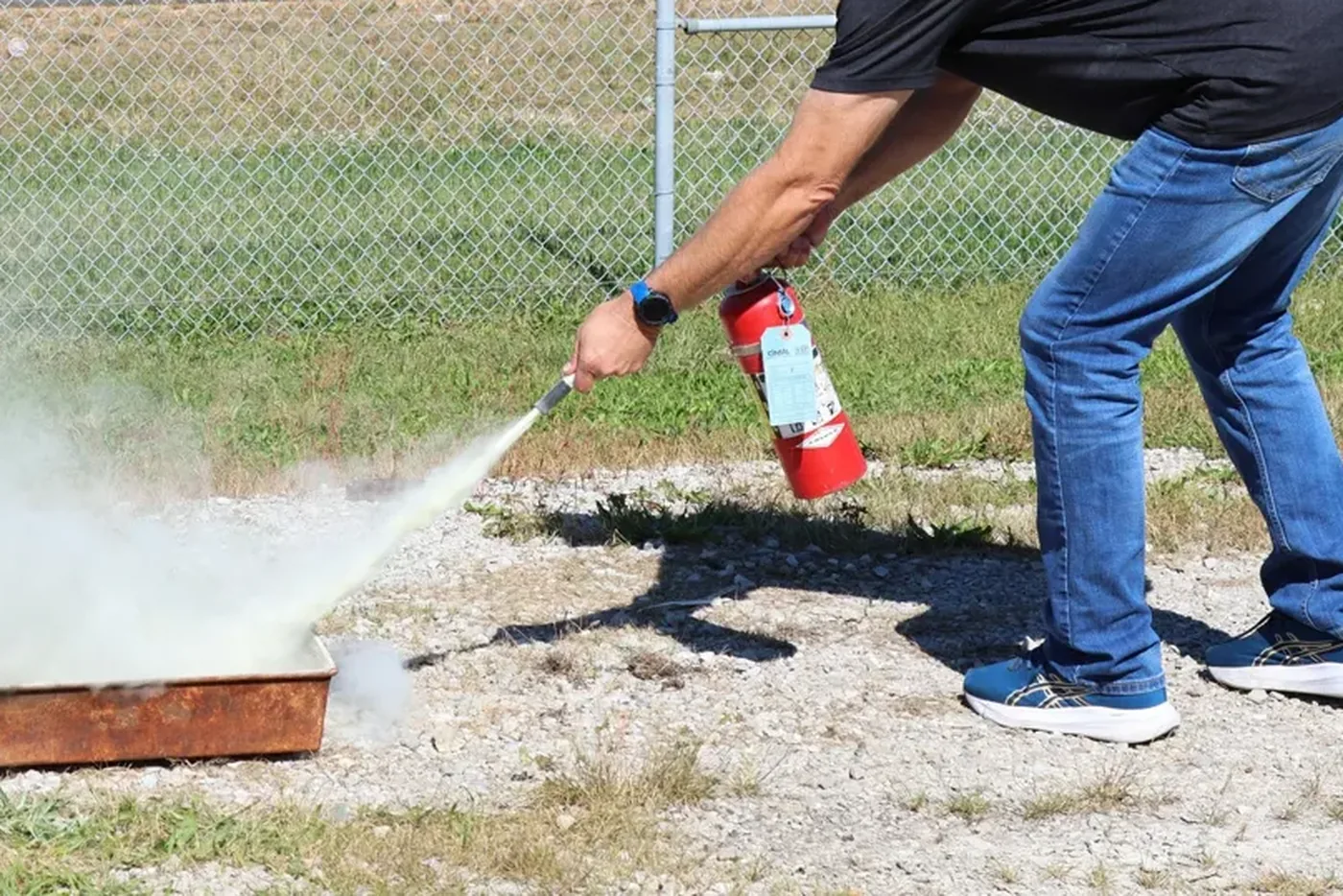
Stand at least 6 to 8 feet from the fire, with your back to a clear exit. Then use P.A.S.S.:
- Pull the pin. This also breaks the tamper seal.
- Aim low, at the base of the fire.
- Squeeze the handle to spray.
- Sweep side to side at the base of the fire until it appears to be out.
Reference: OSHA eTool, Portable Fire Extinguishers: Fire Extinguisher Use · City of Ramsey (MN) Fire Department, Fire Extinguishers
When to stop and get out
- Back away from a fire you put out. It can flare up again.
- Leave right away if the extinguisher is empty and the fire is not out.
- Leave right away if the fire grows past its first stage.
- If you have any doubt you can put it out, leave right away.
Reference: OSHA eTool, Portable Fire Extinguishers: Fire Extinguisher Use
Monthly look, yearly maintenance
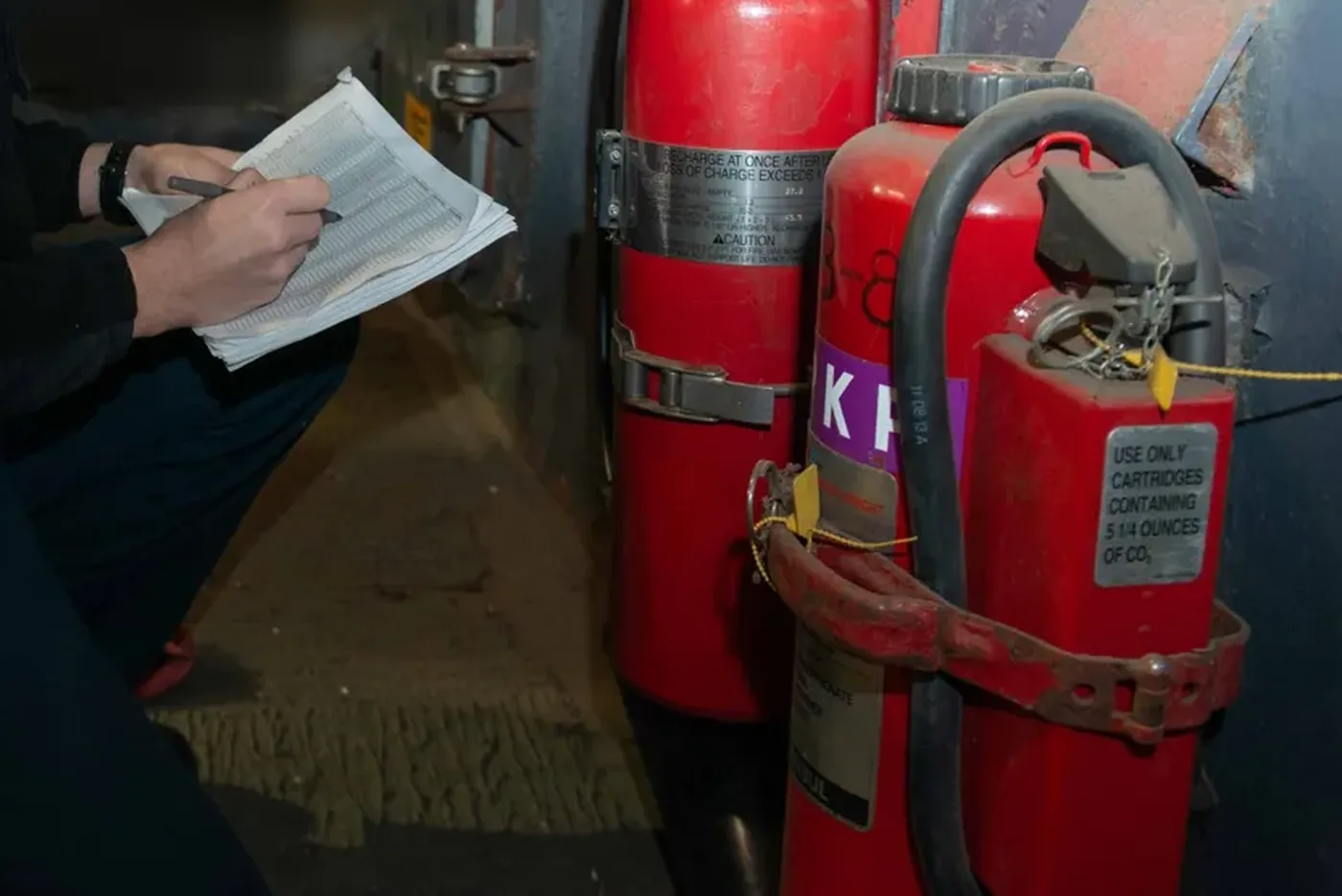
- Every month: someone looks each extinguisher over.
- Every year: it gets a maintenance check, and the date is written down.
- Out for service? When one is taken away to be fixed or refilled, your employer gives you equal protection until it is back.
- Always: it is full, it works, and it stays in its spot unless someone is using it.
What a monthly look checks
- Easy to reach. Nothing blocks it: no boxes, carts or furniture.
- Right pressure. If it has a gauge, the needle shows the right pressure, not too high or too low.
- Pin and seal in place. Pulling the pin breaks the seal, so a broken seal can mean it was used.
- No damage. No dents or rust. The hose and nozzle are clear of bugs and dirt.
- Tag up to date. The inspection tag shows the recent checks.
Some makers say to shake a dry chemical extinguisher once a month so the powder does not pack down. Follow the label.
Want to see a full monthly check? Watch How to Perform a Monthly Fire Extinguisher Inspection from the Fire Equipment Manufacturers' Association (YouTube).
Reference: 29 CFR 1910.157(e)(2) · 29 CFR 1910.157(e)(3) · 29 CFR 1910.157(e)(5) · 29 CFR 1910.157(c)(4) · U.S. Fire Administration, Fire Extinguishers
The bigger checks: 6-year and pressure test
- Every 6 years. Some dry chemical extinguishers (the kind with a 12-year pressure test) are emptied and serviced every 6 years.
- Pressure test (hydrostatic). Trained people do it with the right test equipment. Water and CO2 extinguishers are tested every 5 years. Most dry chemical extinguishers are tested every 12 years.
- Rust or damage means a test now. New rust or damage on an extinguisher means it gets a pressure test.
- Fail means gone. If the tank fails the test, or cannot be tested, it is taken out of use and off the job.
Reference: 29 CFR 1910.157(e)(4) · 29 CFR 1910.157(f)(1) · 29 CFR 1910.157(f)(4) · 29 CFR 1910.157(f)(14) · 29 CFR 1910.157 Table L-1
Two empty extinguishers
What happened. On July 3, 2016, a grease fire started in a wheel hub at a U.S. Postal Service vehicle shop in St. Louis, Missouri. Workers grabbed extinguishers to put it out. At least two of them were not charged. The workers put the fire out only when they found one that was.
What OSHA found
- Not charged. Extinguishers were not kept charged and ready to work.
- No monthly checks. The extinguishers were not looked over every month.
- No training. Workers were not trained to use extinguishers or told the dangers of fighting a fire in its first stage.
- No working alarm. The fire alarm system was not kept up.
OSHA proposed $87,297 in penalties. No one was hurt and the fire was put out fast. OSHA's area director said it could very easily have ended in tragedy.
Reference: OSHA news release 16-1846-CHI (2016) · 29 CFR 1910.157(c)(4) · 29 CFR 1910.157(e)(2) · 29 CFR 1910.157(g)(1)
Common test questions
How far can you have to walk to reach a fire extinguisher for ordinary Class A fires?
75 feet or less. Class A extinguishers must be placed so the travel distance from any employee to an extinguisher is 75 feet or less.
Rule: 29 CFR 1910.157(d)(2)
If your emergency plan names only certain people to use extinguishers, what do you do when the alarm sounds?
Evacuate. Under that kind of plan, everyone except the designated employees leaves the fire area immediately when the fire alarm sounds.
Rule: 29 CFR 1910.157(b)(2)
How often must portable fire extinguishers be visually inspected?
Monthly. Portable extinguishers are visually inspected every month.
Rule: 29 CFR 1910.157(e)(2)
How often do fire extinguishers need a maintenance check?
At least once a year. The employer records the annual maintenance date and keeps the record for one year after the last entry or the life of the shell, whichever is less.
Rule: 29 CFR 1910.157(e)(3)
What happens when an extinguisher is taken away to be recharged?
The employer must provide alternate equivalent protection while it is out of service.
Rule: 29 CFR 1910.157(e)(5)
Need proof of training? The full course (20 min) adds practice questions, a job scenario, the final quiz and a certificate your employer can verify.
Take the courseMore on fire extinguishers at work
Sources
- 29 CFR 1910.157
- OSHA eTool, Portable Fire Extinguishers: Extinguisher Basics
- OSHA eTool, Portable Fire Extinguishers: Fire Extinguisher Use
- OSHA news release 16-1846-CHI (2016)
- City of Ramsey (MN) Fire Department, Fire Extinguishers
- U.S. Fire Administration, Fire Extinguishers
- U.S. Fire Administration, Workplace Fire Safety
Fact-checked against the regulation text on November 01, 2026. This certificate records completion of awareness training based on OSHA 29 CFR 1910.157(a), 1910.157(b)(1), 1910.157(b)(2), 1910.157(c)(1), 1910.157(c)(4), 1910.157(d)(2), 1910.157(d)(4), 1910.157(e)(2), 1910.157(e)(3), 1910.157(e)(4), 1910.157(e)(5), 1910.157(f)(1), 1910.157(f)(4), 1910.157(f)(14), 1910.157(g)(1), 1910.157(g)(2), 1910.157(g)(3) and 1910.157(g)(4), and on OSHA's Portable Fire Extinguishers eTool. It is not an OSHA card or license, and it does not by itself meet the training requirements of 29 CFR 1910.157(g). Where your employer provides portable fire extinguishers for employee use, your employer must still provide an educational program on the general principles of fire extinguisher use and the hazards involved with incipient stage fire fighting upon initial employment and at least annually thereafter, and must provide employees designated to use fire fighting equipment as part of an emergency action plan with training in the use of the appropriate equipment upon initial assignment and at least annually thereafter. Follow your employer's emergency action plan.
This guide explains the rule in plain words. Always read the regulation itself and your employer's site-specific procedures.