Fire Extinguisher Monthly Inspection Checklist (OSHA 1910.157)
A fire extinguisher only helps if it is there, charged and ready when someone grabs it. OSHA wants every portable extinguisher at work checked once a month. This checklist walks you through that monthly check. It also covers the yearly and longer checks.
For what the whole extinguisher rule covers, see our free fire extinguisher safety guide. To teach workers how to use one, see our OSHA Fire Extinguisher Training course.
What the monthly check is
Under 29 CFR 1910.157(e)(2), portable extinguishers get a visual check every month. So does any hose used in place of them. OSHA says the check makes sure the equipment is “in place, charged, and ready for use” (29 CFR 1910.155(c)(27)).
It is a look, not a repair. Checking inside the extinguisher is maintenance. That is a separate yearly job.
In 2006, a company asked OSHA if it could check every three months instead. OSHA said no. Monthly is the rule.
The monthly checklist
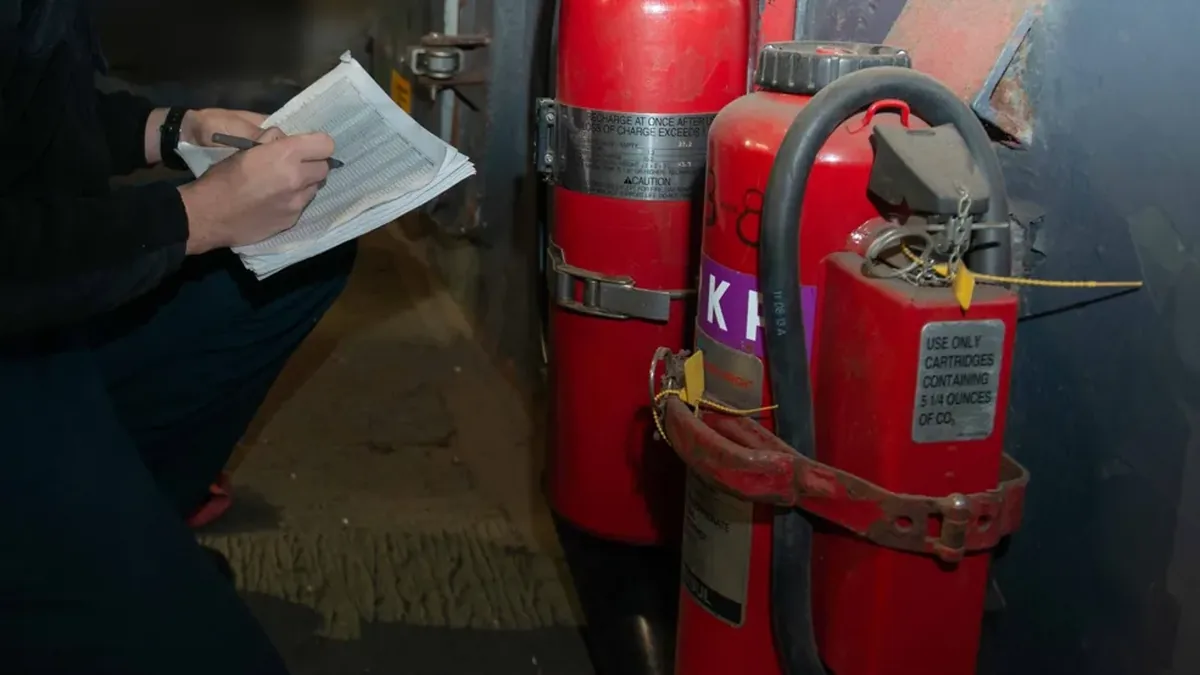
Is it in place?
– [ ] The extinguisher is in its assigned spot. OSHA wants extinguishers kept in their designated places at all times, except while in use (29 CFR 1910.157(c)(4)).
– [ ] It is mounted and marked so people can find it (29 CFR 1910.157(c)(1)).
– [ ] Nothing blocks the way to it, and nobody would have to risk getting hurt to reach it (29 CFR 1910.157(c)(1)).
Is it charged and ready?
– [ ] It is fully charged. If it has a pressure gauge, read it and follow the maker’s label (29 CFR 1910.157(c)(4)).
– [ ] It looks like it will work: nothing missing, bent or broken (29 CFR 1910.157(c)(4)).
– [ ] No new rust, pitting, dents or other damage. New corrosion or mechanical injury means the extinguisher needs a hydrostatic test (29 CFR 1910.157(f)(4)).
– [ ] If it was used, even a little, it goes out for recharging so it is fully charged again.
If it fails
– [ ] Pull it from service and tell whoever handles extinguisher service.
– [ ] Put a working extinguisher, or equal protection, in its place until it comes back (29 CFR 1910.157(e)(5)).
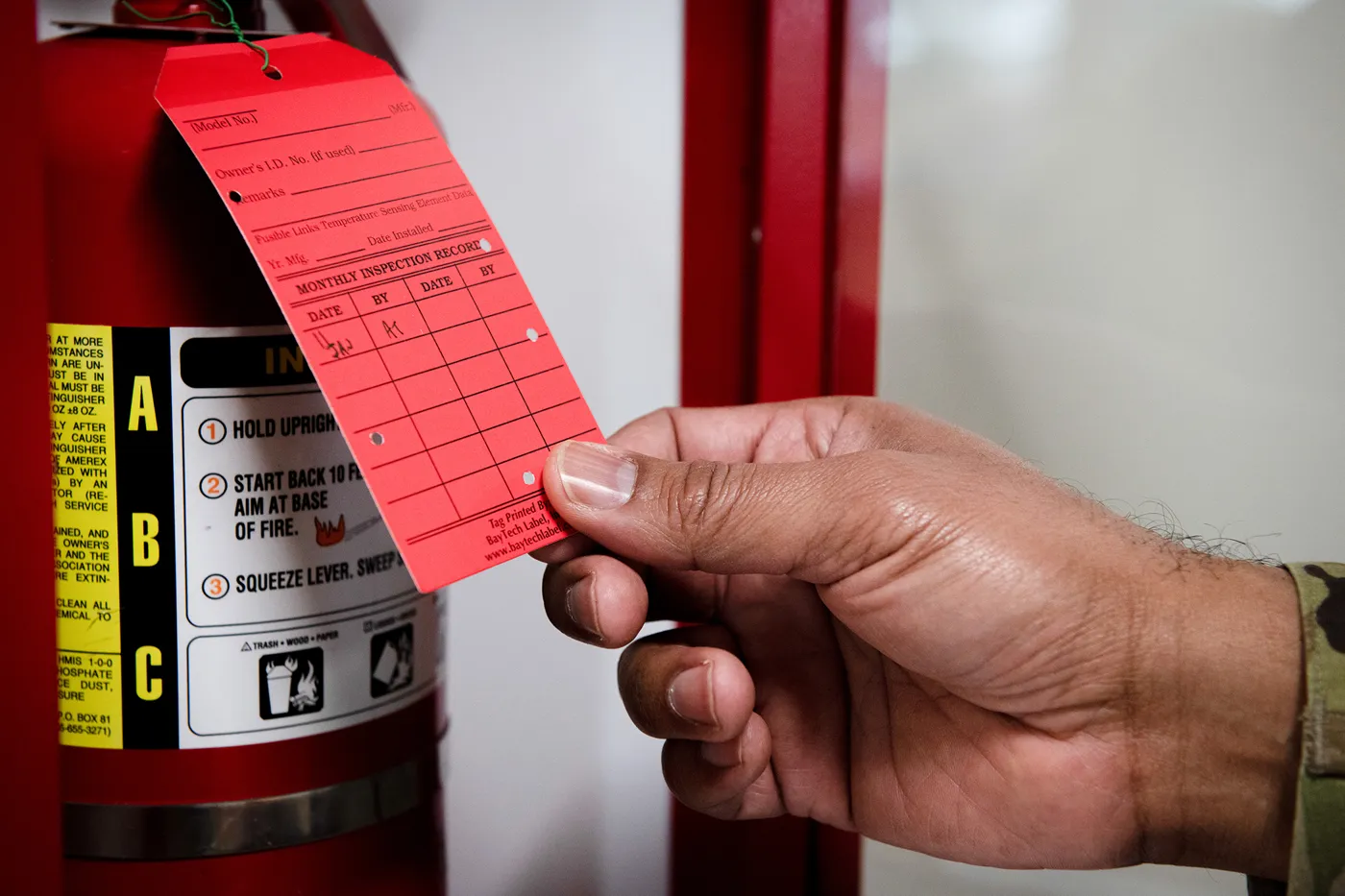
Write it down. The rule asks for a record of the yearly check, not the monthly one. Still, a date and initials on a tag or log is the easy way to show each monthly check got done.
Checking an extinguisher is one job. Using it is another. Our OSHA Fire Extinguisher Training course covers fire classes, the P.A.S.S. technique and when to get out instead, in about 15 minutes, with a certificate your employer can verify.
The yearly and longer checks
Service schedule · 29 CFR 1910.157
Four clocks run on every extinguisher.
One is yours every month. Know when the other three come due before an inspector asks.
- 1MonthYour team
Visual inspection
In its place, charged, and ready to use.
- 1YearEvery year
Maintenance check
Done once a year, with the date recorded.
- 6YearsStored-pressure dry chemical
Empty and service
For units on a 12-year hydrostatic test. The clock restarts after a recharge or a hydrostatic test.
- 5–12YearsTrained tester
Hydrostatic test
Every 5 or 12 years for most types, set by Table L‑1.
Enter the month on the last yearly tag.
The OSHA Fire Extinguisher Training course walks through each check with real photos and a quiz.
See the courseCertificate on completionA few details people miss:
- Keep the yearly record for one year after the last entry or the life of the shell, whichever is less (29 CFR 1910.157(e)(3)).
- Stored-pressure extinguishers do not need an internal examination at the yearly check (29 CFR 1910.157(e)(3)).
- Hydrostatic test records list the test date, the signature of the person who did the test, and the extinguisher’s serial number or other ID. Keep them until the next test or until the extinguisher leaves service (29 CFR 1910.157(f)(16)).
- Who does the work: the employer is responsible for all of it (29 CFR 1910.157(e)(1)). Hydrostatic tests are done by trained people with the right equipment (29 CFR 1910.157(f)(1)). OSHA’s Subpart L Appendix A adds that in-house staff who do this work must be trained for it.
Make it stick
Pick one day each month, like the first Monday, and walk the same route every time. Keep a list of every extinguisher and where it hangs, so a missing one stands out.
Start the OSHA Fire Extinguisher Training course or train your whole crew.
About this post
This post is a plain-language aid, not a copy of the rule. Black Belt Safety is not part of OSHA. The regulation text is what counts.
Sources
- 29 CFR 1910.157 Portable fire extinguishers – Office of the Federal Register (eCFR), checked 2026-10-31
- 29 CFR 1910.155 Scope, application and definitions (fire protection) – Office of the Federal Register (eCFR), checked 2026-10-31
- Interpretation letter, November 29, 2006: monthly versus quarterly extinguisher inspections – OSHA, checked 2026-10-31
- 1910 Subpart L Appendix A, Fire Protection – OSHA, checked 2026-10-31
Frequently asked questions
How often must fire extinguishers be inspected?
Visually every month, with a maintenance check every year.
What does a monthly extinguisher inspection check?
That each extinguisher is in place, mounted and marked, fully charged and ready for use, with no new damage.
Can monthly inspections be done every three months instead?
No. OSHA turned down a request to stretch the monthly schedule to quarterly.
How long do you keep the yearly maintenance record?
One year after the last entry or the life of the shell, whichever is less.