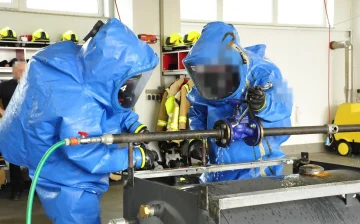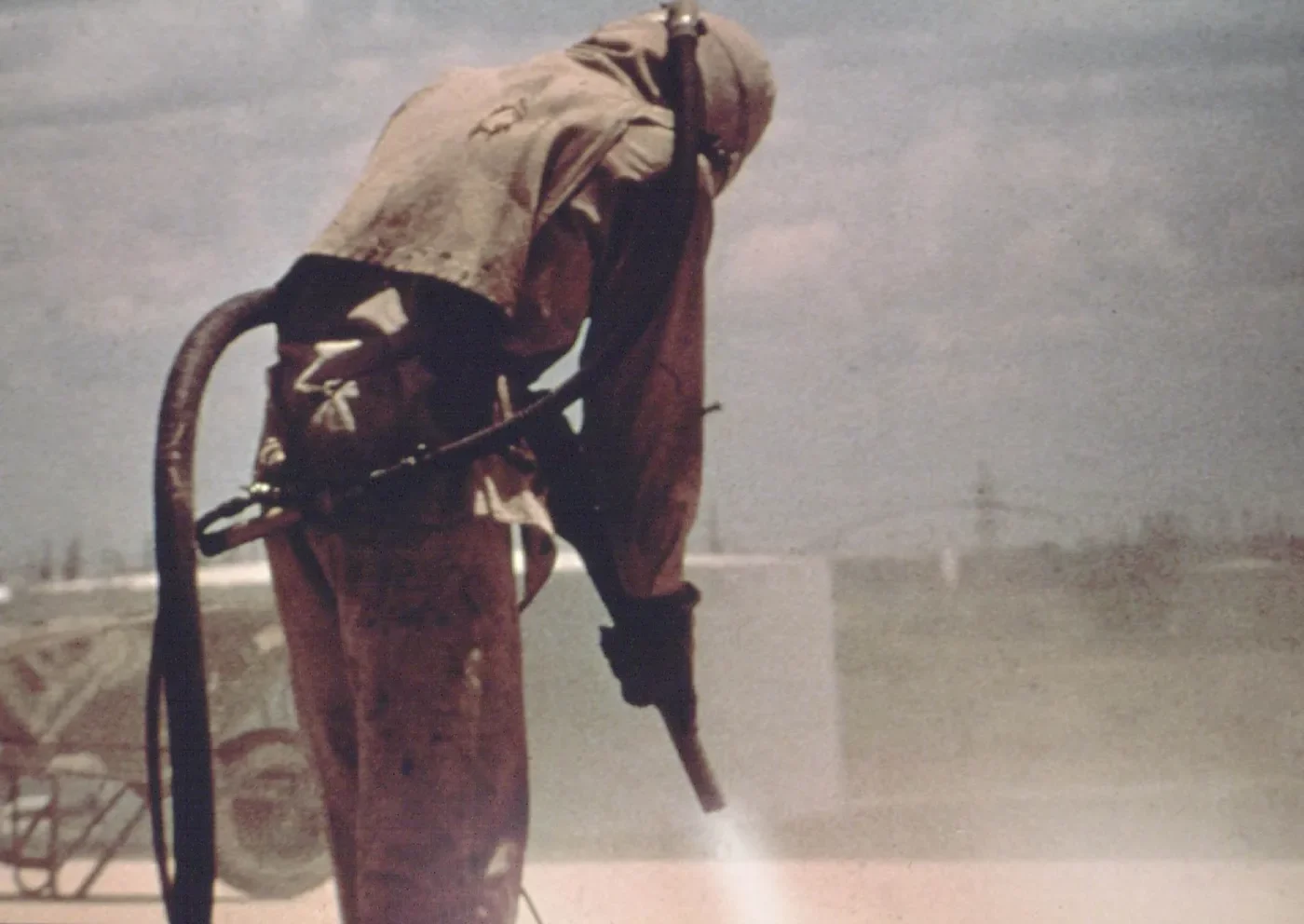
- 5 modules
- 15 pages
- about 25 minutes
Learn what abrasive blasting dust does, when a blasting respirator is required, what other protection you need, and how to work safely around blast-cleaning enclosures and their exhaust ventilation.
What this certificate covers
This certificate records completion of awareness training based on OSHA 29 CFR 1926.57(a), (d)(1), (d)(2), (f)(1)(ii), (f)(1)(iv), (f)(1)(v), (f)(1)(x), (f)(1)(xii), (f)(2)(i), (f)(2)(ii), (f)(3)(i), (f)(4)(i)(a), (f)(5)(i), (f)(5)(ii), (f)(5)(iii), (f)(5)(iv), (f)(5)(v), (f)(6), (f)(7) and (f)(8). It is not an OSHA card or license. 29 CFR 1926.57 has no training requirement for the paragraphs this course teaches, so this course does not replace your employer's procedures for your job. Your employer must still establish a respiratory protection program, as described in 29 CFR 1926.103, wherever it is necessary to use respiratory protective equipment (29 CFR 1926.57(f)(5)(iv)).
Want to submit a review? Login and enrolled
What you will learn
- Say what counts as abrasive blasting and why its dust is a health hazard
- Tell when an abrasive-blasting respirator is required, and what kind of respirator may be used
- Name the other protection that blasting calls for, for operators and for people nearby
- Follow the basic rules for blast-cleaning enclosures and their exhaust ventilation
- Keep dust and spilled abrasive from building up around the work
What you get
- About 25 minutes, on your phone or computer, read out loud as you go
- Real photos, not cartoons
- A hands-on drill: you make the calls, step by step, and see what happens
- 4 quick checks along the way, then a final quiz
- A certificate with a QR code your employer can check online
- A wallet card you can print and carry
Training a crew? Add your workers, see who finished, and keep every certificate in one place. Train your team →
Course outline
- The dust and the limit: What abrasive blasting is, and the dust it makes; Keep the dust below the limit
- Respirators for blasting: When an abrasive-blasting respirator is required; Dust-filter respirators and the respiratory protection program
- Other protection around blasting
- Enclosures, exhaust and housekeeping: Blast rooms, blast cabinets and the air that flows through them; Keep the exhaust running and the dust down
- On the job
Why it matters
Source: OSHA enforcement data, refreshed after each sync.
Questions
What does Ventilation and Abrasive Blasting in Construction cover?
You will be able to: say what counts as abrasive blasting and why its dust is a health hazard; tell when an abrasive-blasting respirator is required, and what kind of respirator may be used; name the other protection that blasting calls for, for operators and for people nearby; follow the basic rules for blast-cleaning enclosures and their exhaust ventilation; keep dust and spilled abrasive from building up around the work.
Who is this course for?
It is written for construction workers.
How long does it take?
About 25 minutes, on a phone or a computer. You can stop and pick up where you left off.
Do I get a certificate?
Yes. Score 80% or better on the final quiz and you get a certificate with a code your employer can check.
Which OSHA rule is it based on?
Based on OSHA 29 CFR 1926.57 (ventilation: paragraphs (a), (d) and the abrasive blasting parts of (f)). It is awareness training: it is not an OSHA card, and your employer still has to train you on their own equipment and plan.
Course facts
- Who it is for: Construction workers
- Trainer: Marc Harvey, Site Safety Officer (OSHA 30, CPR, USACE CQM)
- Time: about 25 minutes, on your phone or computer
- Final quiz pass mark: 80%, with a certificate employers can verify
- Based on OSHA 29 CFR 1926.57 (ventilation: paragraphs (a), (d) and the abrasive blasting parts of (f)) (official text)
Facts checked word for word against the official text (1 sources)
29 CFR 1926.57
Part of The Dojo — OSHA Safety Training Academy
Included from Blue Belt up ($25/month), with every other course in the Dojo.
Get your Blue BeltCompare belts